My husband returned from a week long work trip and opened the backdoor of our brand new house to find the entire yard covered in side-walk chalk. There was chalk on the ground where it belongs, but also on the walls, the screen door, the stucco, and the grill. He looked right at me, “Honey, what happened back here?!?” I gently reminded him that sidewalk chalk is washable, and that I was alone with a toddler for six days.
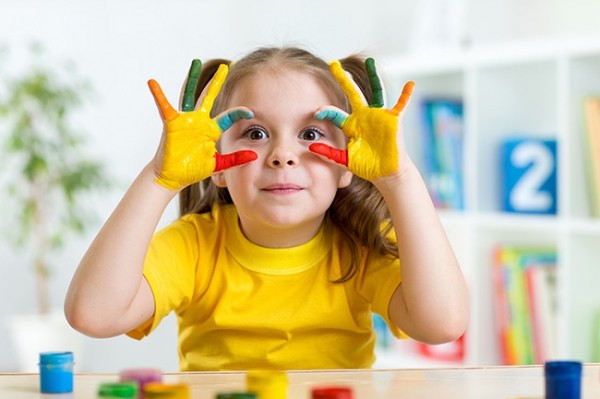
However, this situation is not an isolated incident. It is not uncommon for him to come home to my daughter covered in yogurt head to toe, blocks all over the floor, scraps of tissue paper strewn across the kitchen table, or ten or so pieces of finger-painted “art” taped up around the house.
Before becoming a mama, I taught in special education for six years. I taught students with chart topping IQs who had some fine motor issues, and students who were learning how to feed themselves with a spoon at nine years old. Making messes was an integral part to their education and a vital component to teaching them the skills that they needed to equip them to be successful in school and in life.
Now that I am a mother to a very independent toddler, I am reminded that not only should we not discourage our children from making messes, but that we should actually be fostering this innate desire in our kids, in order to empower them to be the people they were made to be. The thought process behind this can be narrowed down to three essential skills that children can learn when they are encouraged to make messes:
Motor Skills:
Like all muscles, the muscles in our hands need exercise in order to perform the way that they are designed to. Simple acts, like holding a paintbrush, using a spoon, or stacking blocks, help children to build their fine motor skills. When I give my daughter a paint brush and paint, the simple act of dipping the paint brush into the container, removing it, bringing the brush to paper and making a mark is teaching her all sorts of skills. To name a few, she learns hand eye coordination, spatial awareness, fine motor skills, and gross motor skills, while fostering her creativity and self worth.
Related Article: 20 Fine Motor Skill Activities
Self-Control:
When done right, allowing children to make messes actually helps them to be more self-controlled. Our parenting philosophy is mostly based on the idea that we say yes as often as possible, and set boundaries for our children to enjoy their “yes” in! When children feel trusted by adults, and know that they have the freedom to express themselves and their ideas, they are less likely to rebel to gain control.
For example, when her daddy was away, I let her have all access to the sidewalk chalk. I spent the weekend teaching her that she may use chalk whenever she wants, but can only write on the ground or the back wall. After a few slip-ups, she is now able to independently retrieve her chalk and limit it to the spaces that we allowed. We have an easy to clean up mess (in which she hoses it off herself) and she has the freedom to create and explore within healthy boundaries. She is learning to limit herself and follow the rules set for her.
Related Article: 15 Handprint Activities for Toddlers
Responsibility:
This may be one of the most important factors in the idea of encouraging mess making! Parents will make themselves crazy if they take it upon themselves to clean up all of their children’s messes, and subsequently will refrain from allowing children to make messes in the first place. None of us are going to seek out more items for our to-do list. While they are little (starting as young as 12-15 months), our babies need lots of support and encouragement to clean up after themselves.
If we invest this time while they are young, we raise independent, self sufficient, little people who are not making an excessive amount of more work for their parents. We often let our daughter sit in the bathtub to finger paint and get paint all over the bathtub walls. She knows that after painting in the bath, it will be her job to use a sponge and scrub it off, then bathe, and wash her body.
When we encourage children to make messes and clean up after themselves, we allow them to develop a strong awareness of natural consequences and the joy of creating. The sky is the limit when it comes to exploring our children’s gift sets and providing them with hours of entertainment a day when we allow them to be messy.
I recently heard someone say that their parenting approach is to let their kids do all of the things that wouldn’t be acceptable in adulthood! Donning homemade macaroni necklaces, with hands dyed purple, while they bury and dig up dinosaurs hidden in mud pies means that they spent their day making messes. They are being kids who will grow up to be physically and emotionally strong, self-controlled, responsible, and confident contributors to our world.