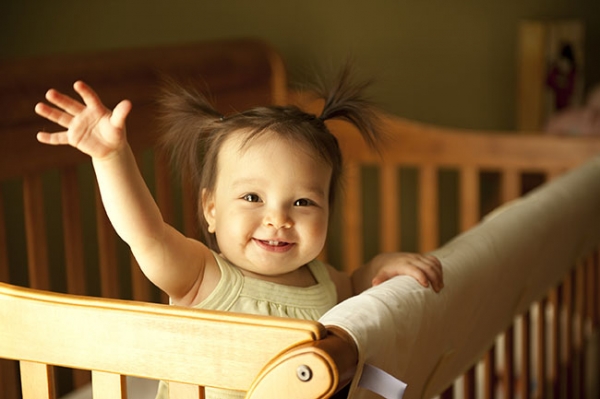
The use of baby sign language has pretty much saved my life and my sanity. I started using it with my toddler because our failure to communicate was causing us both a great deal of stress. There were tears and the stomping of feet coupled with an overall feeling of desperation.
My toddler was not happy about the situation either. I began by teaching her the signs she would need to communicate her basic needs: hunger, thirst, pain, and discomfort (the need for a nap or a diaper change). Once we became fluent with these signs, I started adding signs to our repertoire to help develop my daughter’s oral vocabulary, but these signs are also fun.
Here are 5 of the most fun baby signs!
1. Signs for Food
To make the baby sign for hunger, you make a “c” shape with your hand and then move your arm up and down, from your throat to your stomach, like food going down. I have found rubbing the tummy to be a more effective way to teach this sign, as it is what we naturally seem to do when we feel hungry as adults. You could also use the sign for “eat”, in which you pinch all of your fingers together and move them to your mouth like you are eating.
These signs for hunger are different than making signs for different types of food. These signs are fun to make and give you a sense of your child’s food preferences very early on. Once your child learns numerous signs for foods, you can find yourself in danger of becoming a short order cook!
I like to present my daughter with two choices. For example, offering two different fruit choices with her morning oatmeal, like “strawberry” (pinching the fingers of one hand together and making a twisting motion around the pointer finger of your opposite hand) or “banana” (motioning as if you are peeling a banana).
You can learn the signs along with your child and make everyday tasks like cooking dinner and going grocery shopping opportunities to engage in actual conversation!
2. Signs for Animals
If you have a pet, these are great signs to begin with. The sign for “dog” is made by slapping your leg, as if calling a dog. My daughter slaps her bum instead, which I find too hysterical to correct. The objective it to encourage communication with your child, so you may have to make some modifications to the signs and that is okay!
You may also pair the sign with your pet’s name and you will discover that your pet may begin responding to both the sign and verbal commands. I have found that the ability to communicate with our dog has increased my daughter’s confidence when attempting verbal approximations.
For some great belly laughs, teach your child the sign and the sound an animal makes the next time you are reading an animal picture book. This combination of audio, visual, and kinesthetic cues speaks to your child’s multiple intelligences. The animal signs are fun to act out, as well.
For example, you pretend like your arm is a trunk when making the sign for “elephant” and scratch your arm pits to make the sign for “monkey”. Before you know it, it will appear as if your entire family is engaged in a game of animal charades.
3. Signs in Nursery Rhymes
Nursery rhymes are a great way to build your child’s early literacy skills. Rhyme and repetition help develop phonemic and phonological awareness. These are the building blocks of reading.
Nursery rhymes also improve your child’s cognitive development, as it builds memory capabilities. Adding the physical component of adding signs to the rhymes also improves memory of the rhyme, while teaching rhythm. Singing, dancing, signing, and performing these classic rhymes will also build your child’s confidence. Go ahead, do the “Itsy Bitsy Spider” song with your child for the millionth time today. You are actually setting your child up for life long success!
Related Article: The Baby Signs That Changed My Life
4. Signs for Hobbies/Interests
The sign for “play” is like making the “hang loose” sign with both hands (extending out your pinkies and thumbs while keeping the rest of your fingers together). This is a fun sign for people of any age to act out, but you can couple this sign with other signs that reflect your child’s interests. For example, you could pair “play” with “ball” (palms facing one another, fingers extended like you are holding a grapefruit, then moving your hands together and apart) to ask if your child wants to play with the ball.
You can tailor your sign language acquisition to include the particular objects and activities that your child is interested in.
You might want to learn the words for car, truck, and motorcycle or the words for musical instruments, depending on the child. Of course, if your child is like mine, you will soon develop an immense sign vocabulary as his/her interests and fascinations change daily!
5. Signs for Feelings
One of the most important aspect of communication is the ability to convey our feelings and emotions to another. Our little ones are bundles of emotions, both positive and negative. It usually pretty obvious when your child is happy because he/she will squeal in delight and clap their hands and it is even more apparent when your child is unhappy because you will hear about it at the top of their lungs. Conversations about how and why our children feel the way they do can begin right now through sign language.
To make the sign for “happy”, act like you are brushing your hands in circles up your chest a few times. When making this sign, it helps to smile broadly to emphasize the feeling. You can begin asking your child if they are happy and what makes them happy. My daughter loves to let me know how happy it makes her to pet our dog…or any other dog for that matter. I knew from the expression on her face that she loved petting dogs, but showing her how to share the inner workings of her young mind has set the stage for, what I hope will be, a lifetime of open communication.
I validate her feelings by making the sign back to her and then pepper her with questions like, “Do you like the dog’s soft fur?” “Do you love to snuggle with your dog?” “Were those kisses wet?” I am trying to teach her to think about her feelings while also attempting to expand her vocabulary with words like soft and wet.
Similarly, it is important to get your child in the habit of explaining why they are upset when they start melting down, so that you may problem solve together. The sign for “frustrated” is making by taking one hand to the opposite cheek like you are saying, “I have had it up to here!” The sign for “sad” is made by running your fingers down your face like imaginary tears are falling.
My goal is to teach my daughter to differentiate between these emotions, so that she can find the appropriate solution. For example, she is most likely sad that our dog no longer wants to play fetch with her, but frustrated when she cannot get the lid off the container of Legos. In the first instance, I can show her how to find another activity where she can play without our dog (who most likely needs a toddler break!) and the second instance, I can ask if she needs help to accomplish her task. (The sign for help is made by making the “thumbs up” sign with one hand and placing that hand in the palm of the other.) Again, I want to validate my daughter’s feelings, but I also want her to express her feelings in an appropriate way and begin developing problem solving strategies.
One of the best signs for feelings, or any sign for that matter, is the sign for “I love you”. To make this sign, put your thumb, index, and pinkie finger up and your ring and middle fingers down. Then, wave your hand back and forth. The day my daughter just looked up at me with her big, brown eyes and made the “I love you” sign followed by a giant hug around the legs, brought me to tears.
As you are learning sign language along with your child, remember that it is okay to make modifications to best suit your needs. Once you have introduced a sign, keep practicing it consistently, even after your child has mastered it. Add to your sign language vocabulary based on the needs of you and your child. Most importantly, have fun!