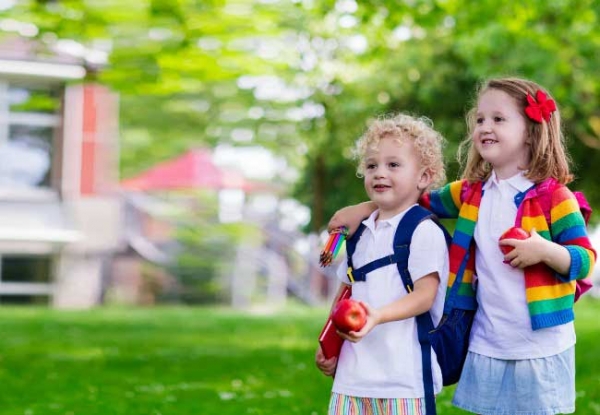
Another summer is coming to an end. Back-to-school items are bursting out of shelves everywhere. Backpacks, notebooks, pencils, calculators, you can find all the material necessities to get your child ready for the new school year, but there are some things your child needs before the first day of school that money can’t buy. Below is a list of skills that will help make your child’s school year successful.
Assertiveness
We want our children to stand up for themselves and what they believe in. We want them to confidently communicate their ideas and feelings. These are skills that can be taught which will help our children to be more successful in their personal and, one day, professional lives. Assertiveness helps kids build confidence, healthy relationships, and self-esteem. Assertiveness isn’t bossiness or aggression. It isn’t being demanding without considering the feelings of others. Assertiveness is the ability to create boundaries and advocate for oneself. To teach your child to be assertive:
-
- Model assertiveness. When you create a boundary and hold it with empathy, you are modeling assertiveness. When you state what you need from your child in a respectful way, you’re modeling assertiveness. When you speak up at the restaurant that your order is wrong but you do so showing respect and kindness, you model assertiveness.
- Give your child choices. Allowing her to choose her own hairstyle or clothing teaches her that her voice matters. Of course, children can’t always make their own decisions or they’d have chips and fruit snacks for dinner, but giving them control where you can will help them build this skill.
- Teach your child to speak up. Role-playing is a great way to teach assertiveness skills because you can practice what words to say and the tone in which to say them. Practice this several times a week until your child feels comfortable with it.
Find more examples of assertiveness here and learn more tips for teaching your child this skill here.
Problem-Solving
Children who can solve problems and think outside the box possess a valuable skill as this helps them cope with the problems they will face. This skill takes time to develop, and young children need a lot of help from their parents. Yet, as children get older, we should allow them to take more control over their problems. This builds creativity, persistence, and confidence.
- Identify the problem. Teach your child to state clearly what the problem is. “I want the doll but Janice has it.”
- Generate solutions. Once the problem has been identified, brainstorm solutions with your child. Try to give your child the leeway here, offering ideas if they get stuck. “If you take the doll, how would that play out? Yes, that would lead to an argument and isn’t respectful. What about asking Janice for a turn or finding another doll to play with?”
- Follow through with your solution and see if it works. If she decides to ask for the doll and Janice tells her she will get a turn next, then help her wait patiently until her turn comes. If Janice seems to forget or just puts the doll down, have her say, “May I have my turn now?” If Janice is unwilling to share, brainstorm new solutions.
- If the solution fails, go back to step 2.
Read my article Raising a Problem-Solver.
Effective Communication
Positive communication skills
- Teach her to use “I feel” statements. “I feel sad when you won’t let me play” is both assertive and good communication as it does not attack the other person.
- Help your child develop good listening skills. Read aloud to them and then ask questions about what you just read. Tell them about your day and have them repeat back to you what you said. Practicing this often will help your child become an excellent listener.
-
- Talk to your child about nonverbal language. Practice by using several body gestures and ask her what it communicates. You might try slumping over and looking away, rolling your eyes, crossing your arms, and different facial expressions.
Friendship Skills
Some children just seem to be a natural at making friends. They get invited to all the parties and are always surrounded by a group. Others struggle with this crucial skill. Fortunately, teaching your child good social skills will help them make friends and build positive relationships. Below is a list of friendship making skills to work on with your child. Again, role-play is a valuable teaching tool here.
- Eye contact
- Active listening
- Knows how to start a conversation
- Asks to join in
- Exhibits good manners
- Emotional intelligence (identifies and expresses them appropriately)
- Respects personal space
- Read social cues