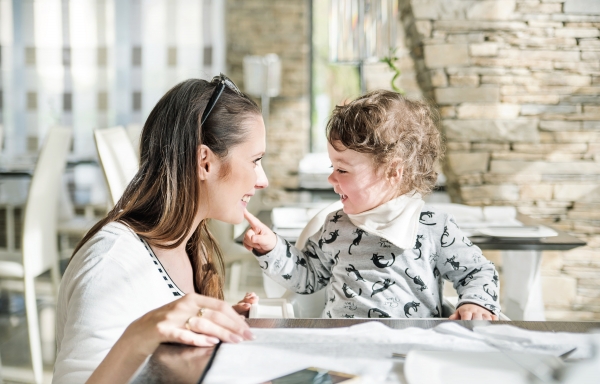
We all want to raise emotionally intelligent children because we understand how beneficial it is to their health, happiness, and success. Yet, how are we handling our own emotions? Are we steady or easily thrown? Can we control our moods and impulses? Are we mindfully aware of our emotional states and how they are affecting our children and families? Are we able to meet our children with empathy or are we quick to dismiss, judge, or react? Emotional intelligence is just as important for us as it is for our children, and learning to manage our emotions will help us be a better and more joyful parent.
Two psychologists, John Mayer and Peter Salovey, are credited for coining the term “emotional intelligence,” but it was Daniel Goleman, a science journalist, who brought “emotional intelligence” to the forefront with his books, Emotional Intelligence, Working with Emotional Intelligence, and Social Intelligence. According to Goleman, there are 5 components of emotional intelligence which we will look at today from the perspective of a parent to see how we, ourselves, can raise our own emotional intelligence.
Self-Awareness
Self-awareness is “the ability to recognize and understand personal moods and emotions and drives, as well as their effect on others.” For me, learning this has been a process. I used to believe my mood was entirely created by the circumstances or environment I was in, but I’ve since learned (and am still working on applying) the fact that my mood and my emotions are a direct result of my thoughts, and learning to manage my thoughts has been a big work of parenting for me. If I went through my day letting everything my kids do “wrong” frustrate me and throw me into a sour mood, I would be giving away so much joy and, honestly, I’d be giving a lot of power to my children. Self-awareness comes through being mindful, keeping a finger on the pulse of my thoughts and feelings and adjusting as necessary.
Self-Regulation
Self-regulation includes “the ability to control…disruptive impulses and moods and to…think before acting.” It doesn’t do much good to have self-awareness if I don’t have self-regulation, yet self-awareness is obviously a critical element as I cannot control that which I am not aware of. My favorite tips for self-regulation is placing a hand over my heart as I breathe deeply and repeat a mantra such as “we are okay” before I respond when I feel my agitation rising and also carrying a laminated photo of my children as babies in my pocket to look at when I’m beginning to lose my cool. There are plenty of calming techniques we can use once we become self-aware of our emotions. The trick is to expand that space between action and reaction and find what best works for you in that interim.
Internal Motivation
I actually adore part of the definition given of this one. “An inner vision of what is important in life, a joy in doing something.” I am a huge believer in resetting my mind daily to my vision, and I’m always recommitting to finding joy in the chaos of parenthood. To help me with this, I’ve written down my mothering blueprint – a vision for the parent I want to be and the goals I want to achieve. When I make it a habit to read through this daily, I am much better at staying on track. I have also found it beneficial to spend time with like-minded people, so I listen to podcasts, read books, and chat with friends who all share my vision. Of course, internal motivation means a passion for work that goes beyond money or status, so to me that means finding joy in my own life as a woman – separate from parenting. That’s why I write! It isn’t just to help pay the bills, it’s because I love to share the message of connected, respectful parenting and relationships!
Empathy
“The ability to understand the emotional makeup of other people.” The ability to put yourself in the shoes of another is how I think of empathy. As a parent, it helps me to take off my mommy slippers and seek to see any given situation through the eyes of my child. Practicing this skill helps me to show up with kindness and gentleness and also helps me to self-regulate when I feel annoyed at a situation. Two ways to increase your empathy is by practicing compassion meditation (sending out well wishes to others) and becoming an active listener, watching for facial cues and really trying to understand the emotion and experience behind the words.
Social Skills
This is “proficiency in managing relationships” and, applying this as a parent means building secure relationships with my children and managing that relationship through the ups and downs raising children. Social skills for the parent/child relationship mean setting aside our adult agendas to engage in our child’s world, to listen to understand rather than reply, and to practice positive communication skills.
Resources:
Daniel Goleman’s Five Components of Emotional Intelligence -- https://web.sonoma.edu/users/s/swijtink/teaching/philosophy_101/paper1/goleman.htm