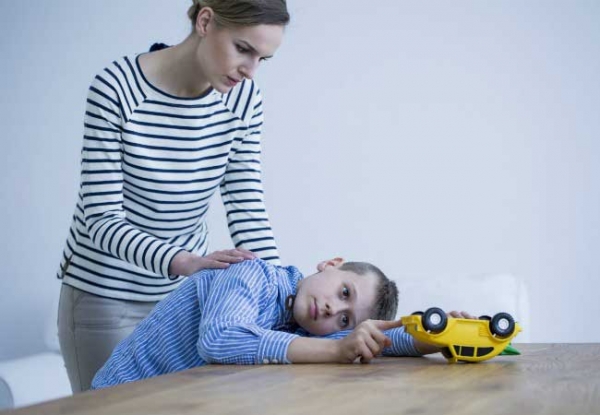
Empathy is a key element in emotional intelligence. Teaching children emotional intelligence (a “person’s ability to identify, evaluate, control, and express emotions) has proven to be extremely important for social and academic achievement. Here are five ways to teach your child this critical skill:
1. Become an emotion coach and teach them tools for emotional self-regulation. Helping our children to understand and handle their own emotions will help them, in turn, to be able to better understand the emotions of others. Emotion coaches are parents who view emotions as an opportunity to connect and teach. They first meet emotion with understanding and empathy and then set limits or problem-solve, depending upon whether the misbehavior was connected to the emotion. In my article titled Becoming an Emotion Coach, I outlined 3 ways to accomplish this:
a. Help children verbally label their emotions. Children must understand them in order to be able to regulate them.
b. Validate and accept all emotions while communicating your values on behavior. For example, feeling angry is acceptable; hitting is not. It’s important to empathize even when misbehavior has occurred because this shows children that you understand what he or she is feeling and provides a “magic moment” where the connection enables you to teach a lesson.
c. Set limits where there is misbehavior. Example: “I understand that you are angry, but I will not allow you to hit. Come sit by me. When you’re angry, you need to take deep breaths or walk away.” State what is acceptable and unacceptable, give a reason for limit setting, and emphasize the specific positive behaviors your child can do rather than only stating the negative behavior.
2. Seize opportunities to point out and talk about the emotions of others. Whether it is observing an incident at a park or watching TV, talk with kids about the experiences of others and how they might be feeling as a result. This helps children learn to put themselves in another’s shoes.
In one study on Dutch school children, Jellie Sierksma and her colleagues gave the students different scenarios involving a classmate whose turn it was to stay after school and clean up the classroom. This classmate was in a hurry to get home because her mother was ill and was asking for help. The children were first asked to imagine the girl was a friend and asked if they stay and help the girl. They were then asked to imagine this girl was not a friend; would they stay and help now? Not surprisingly, the children showed less willingness to help when the girl wasn’t viewed as a friend.
However, when the experimenters first asked the children to think about that classmate and rate how sad or upset she would be, the children showed no bias in favor of a friend. They were equally likely to help the girl.
3. Read and role-play. Neuroscientists mapping the brain have discovered that reading fiction taps into the same brain networks as real life experience. Reading fiction can improve the reader’s ability to put themselves in another’s shoes and improves Theory of Mind (the ability to attribute mental states – beliefs, intents, desires, knowledge, etc. – to oneself and others and to understand that others have mental states different from one’s own.)
Role-play helps kids practice for real-life situations. Try role-playing with your kids various circumstances such as:
a. You are playing with your friends at recess and notice one person who has no one to play with. What do you do?
b. You notice a person on crutches who is having a difficult time getting the door open. What do you do?
c. Your friend’s hamster died. What do you say?
4. Drop rewards and punishments. Research has shown that children are more likely to develop an internal sense of morality when their parents use a discipline approach that emphasizes rational explanation and moral consequences rather than arbitrary rules and punishments.
In her book Un-selfie: Why Empathetic Kids Succeed in Our All-About-Me World, author Michele Borba suggests four steps to help a child respond more empathetically. CARE. 1) Call attention to uncaring behavior, 2) assess how uncaring affects others and help kids to understand the other’s perspective, 3) repair the hurt and make amends, and 4) express disappointment for uncaring behavior while stressing expectations of caring behavior in the future. Allowing children to have these “do-overs” is much more beneficial to developing empathy than simply enduring a punishment for uncaring behavior.
5. Focus on helping the child connect actions with outcomes rather than forcing apologies. Most young children do not really understand the concept of apologies. While it may feel “right” to make them apologize, it isn’t – in and of itself- helpful in developing empathy. Instead, help your child to be observant of how their actions affect others. “Look at Jackson. He’s crying and holding his knee. When you pushed him down, he landed on that knee and now it hurts. Let’s go check on him and make sure he’s okay.”